


 1
1title: Greek Calyx-Krater with Driver, Chariot, and Three Horses - Walters 482060 - Side B
artist:
Anonymous (Greece)date: 2nd quarter 4th century BC (Classical)
medium: Technique terracotta
dimensions: with handles: size cm 22.2 16.7 (h. x diam.); at mouth: size cm 19.3 (diam.); at foot: size cm 9.5 (diam.)
current location: Gift of Robert Garrett, 1952
credit: Walters Art Museum:
 Home page
  Info about artwork
description: This red-figure calyx-krater depicts Nike on the front driving in a triga to the right. She holds the reins in her outstretched hands, as well as a goad in her left. She wears a peplos, bracelets, and diadem. Above the right handle hangs the lower half of a shield. On the back are three mantled youths, two to the right and one to the left.
license:Public domain
 2
2title: Greek Black-figure Volute Krater - Walters 4829 - View A Detail
artist:
Anonymous (Greece)date: between circa 525 and circa 500 BC
medium: Technique terracotta
dimensions: H: 23 1/16 x W: 20 1/2 x Diam: 16 15/16 in. (58.5 x 52 x 43 cm)
current location: Acquired by Henry Walters with the Massarenti Collection, 1902
credit: Walters Art Museum:
Home page Info about artworkdescription: Beneath the meander-adorned rim of this large volute krater is a band of figural decoration interrupted by the handles on each side. At the center of the scene on one side is a trio of warriors, each wearing a short chiton and a full panoply of armor. The central figure lunges deeply to the right as he looks back at the soldier behind him. The figure on the left prepares to plunge his raised spear into the central warrior. The third soldier, on the right, also wields a spear in his upraised right hand, poised to strike. Flanking this central pair are two women in long, decorated garments. Each raises her hands, as if to address the men or express alarm. Behind the woman on the right is a horse and young man, perhaps a groom. Beyond them are four more figures, including a naked youth with a mantle, two men with staffs, and another fully armed warrior. To the left of the central scene, behind the woman, an armed warrior mounts a chariot, as if ready to flee from the fighting. A man seated in front of the horses interrupts the sense of motion evoked by the charioteer. The two figures behind the seated man resemble those at the other end of the scene: a naked youth wearing a mantle and holding a staff or spear and a standing man in longs robes with a staff.
Reminiscent of the central trio of warriors, three figures occupy the center of the scene on the opposite side, in a representation of Herakles wrestling the Nemean lion, with a youth, perhaps Iolaos, at hand offering support as he holds the hero's club. As with the composition on the other side, the figures are flanked by two female figures - a seated Athena on the right and a woman fleeing on the left. Further connecting the scenes is the depiction of charioteers mounting their chariots, which once again face seated men with staffs. A standing man with a staff frames the scene at either end.
Warriors figure prominently on both sides of this vase, which appears to celebrate the physical prowess of the central figures. The scenes highlight conduct in war and wrestling, two activities in which male citizens would have been trained and encouraged to emulate their heroic prototypes.license:Public domain
 3
3title: Greek Black-figure Volute Krater - Walters 4829 - View B
artist:
Anonymous (Greece)date: between circa 525 and circa 500 BC
medium: Technique terracotta
dimensions: H: 23 1/16 x W: 20 1/2 x Diam: 16 15/16 in. (58.5 x 52 x 43 cm)
current location: Acquired by Henry Walters with the Massarenti Collection, 1902
credit: Walters Art Museum:
Home page Info about artworkdescription: Beneath the meander-adorned rim of this large volute krater is a band of figural decoration interrupted by the handles on each side. At the center of the scene on one side is a trio of warriors, each wearing a short chiton and a full panoply of armor. The central figure lunges deeply to the right as he looks back at the soldier behind him. The figure on the left prepares to plunge his raised spear into the central warrior. The third soldier, on the right, also wields a spear in his upraised right hand, poised to strike. Flanking this central pair are two women in long, decorated garments. Each raises her hands, as if to address the men or express alarm. Behind the woman on the right is a horse and young man, perhaps a groom. Beyond them are four more figures, including a naked youth with a mantle, two men with staffs, and another fully armed warrior. To the left of the central scene, behind the woman, an armed warrior mounts a chariot, as if ready to flee from the fighting. A man seated in front of the horses interrupts the sense of motion evoked by the charioteer. The two figures behind the seated man resemble those at the other end of the scene: a naked youth wearing a mantle and holding a staff or spear and a standing man in longs robes with a staff.
Reminiscent of the central trio of warriors, three figures occupy the center of the scene on the opposite side, in a representation of Herakles wrestling the Nemean lion, with a youth, perhaps Iolaos, at hand offering support as he holds the hero's club. As with the composition on the other side, the figures are flanked by two female figures - a seated Athena on the right and a woman fleeing on the left. Further connecting the scenes is the depiction of charioteers mounting their chariots, which once again face seated men with staffs. A standing man with a staff frames the scene at either end.
Warriors figure prominently on both sides of this vase, which appears to celebrate the physical prowess of the central figures. The scenes highlight conduct in war and wrestling, two activities in which male citizens would have been trained and encouraged to emulate their heroic prototypes.license:Public domain
 4
4title: Greek Black-figure Volute Krater - Walters 4829 - View B Detail
artist:
Anonymous (Greece)date: between circa 525 and circa 500 BC
medium: Technique terracotta
dimensions: H: 23 1/16 x W: 20 1/2 x Diam: 16 15/16 in. (58.5 x 52 x 43 cm)
current location: Acquired by Henry Walters with the Massarenti Collection, 1902
credit: Walters Art Museum:
Home page Info about artworkdescription: Beneath the meander-adorned rim of this large volute krater is a band of figural decoration interrupted by the handles on each side. At the center of the scene on one side is a trio of warriors, each wearing a short chiton and a full panoply of armor. The central figure lunges deeply to the right as he looks back at the soldier behind him. The figure on the left prepares to plunge his raised spear into the central warrior. The third soldier, on the right, also wields a spear in his upraised right hand, poised to strike. Flanking this central pair are two women in long, decorated garments. Each raises her hands, as if to address the men or express alarm. Behind the woman on the right is a horse and young man, perhaps a groom. Beyond them are four more figures, including a naked youth with a mantle, two men with staffs, and another fully armed warrior. To the left of the central scene, behind the woman, an armed warrior mounts a chariot, as if ready to flee from the fighting. A man seated in front of the horses interrupts the sense of motion evoked by the charioteer. The two figures behind the seated man resemble those at the other end of the scene: a naked youth wearing a mantle and holding a staff or spear and a standing man in longs robes with a staff.
Reminiscent of the central trio of warriors, three figures occupy the center of the scene on the opposite side, in a representation of Herakles wrestling the Nemean lion, with a youth, perhaps Iolaos, at hand offering support as he holds the hero's club. As with the composition on the other side, the figures are flanked by two female figures - a seated Athena on the right and a woman fleeing on the left. Further connecting the scenes is the depiction of charioteers mounting their chariots, which once again face seated men with staffs. A standing man with a staff frames the scene at either end.
Warriors figure prominently on both sides of this vase, which appears to celebrate the physical prowess of the central figures. The scenes highlight conduct in war and wrestling, two activities in which male citizens would have been trained and encouraged to emulate their heroic prototypes.license:Public domain
 5
5title: Greek Black-figure Volute Krater - Walters 4829 - View A
artist:
Anonymous (Greece)date: between circa 525 and circa 500 BC
medium: Technique terracotta
dimensions: H: 23 1/16 x W: 20 1/2 x Diam: 16 15/16 in. (58.5 x 52 x 43 cm)
current location: Acquired by Henry Walters with the Massarenti Collection, 1902
credit: Walters Art Museum:
Home page Info about artworkdescription: Beneath the meander-adorned rim of this large volute krater is a band of figural decoration interrupted by the handles on each side. At the center of the scene on one side is a trio of warriors, each wearing a short chiton and a full panoply of armor. The central figure lunges deeply to the right as he looks back at the soldier behind him. The figure on the left prepares to plunge his raised spear into the central warrior. The third soldier, on the right, also wields a spear in his upraised right hand, poised to strike. Flanking this central pair are two women in long, decorated garments. Each raises her hands, as if to address the men or express alarm. Behind the woman on the right is a horse and young man, perhaps a groom. Beyond them are four more figures, including a naked youth with a mantle, two men with staffs, and another fully armed warrior. To the left of the central scene, behind the woman, an armed warrior mounts a chariot, as if ready to flee from the fighting. A man seated in front of the horses interrupts the sense of motion evoked by the charioteer. The two figures behind the seated man resemble those at the other end of the scene: a naked youth wearing a mantle and holding a staff or spear and a standing man in longs robes with a staff.
Reminiscent of the central trio of warriors, three figures occupy the center of the scene on the opposite side, in a representation of Herakles wrestling the Nemean lion, with a youth, perhaps Iolaos, at hand offering support as he holds the hero's club. As with the composition on the other side, the figures are flanked by two female figures - a seated Athena on the right and a woman fleeing on the left. Further connecting the scenes is the depiction of charioteers mounting their chariots, which once again face seated men with staffs. A standing man with a staff frames the scene at either end.
Warriors figure prominently on both sides of this vase, which appears to celebrate the physical prowess of the central figures. The scenes highlight conduct in war and wrestling, two activities in which male citizens would have been trained and encouraged to emulate their heroic prototypes.license:Public domain
 6
6title: Greek Calyx-Krater with Driver, Chariot, and Three Horses - Walters 482060 - Side A
artist:
Anonymous (Greece)date: 2nd quarter 4th century BC (Classical)
medium: Technique terracotta
dimensions: with handles: size cm 22.2 16.7 (h. x diam.); at mout size cm height=19.3 (diam.); at foot: size cm 9.5 (diam.)
current location: Gift of Robert Garrett, 1952
credit: Walters Art Museum:
Home page Info about artworkdescription: This red-figure calyx-krater depicts Nike on the front driving in a triga to the right. She holds the reins in her outstretched hands, as well as a goad in her left. She wears a peplos, bracelets, and diadem. Above the right handle hangs the lower half of a shield. On the back are three mantled youths, two to the right and one to the left.
license:Public domain
 7
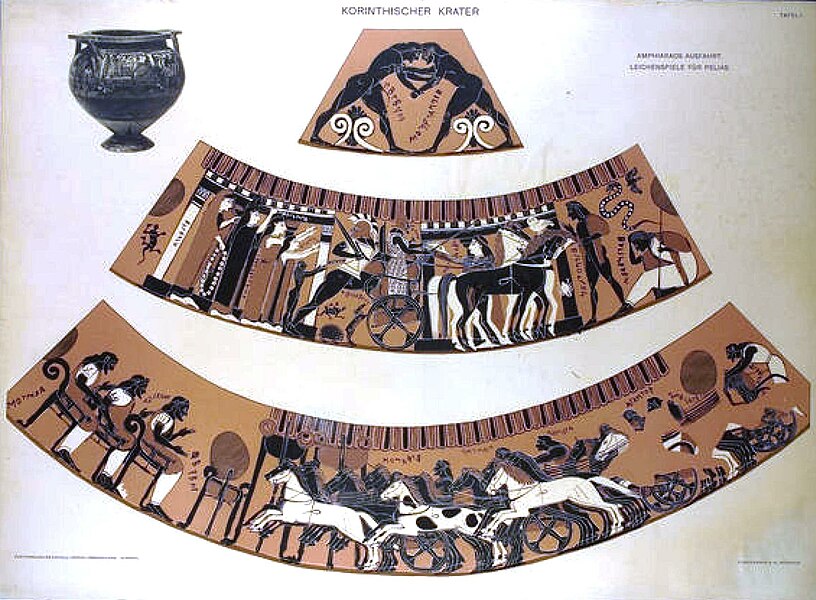
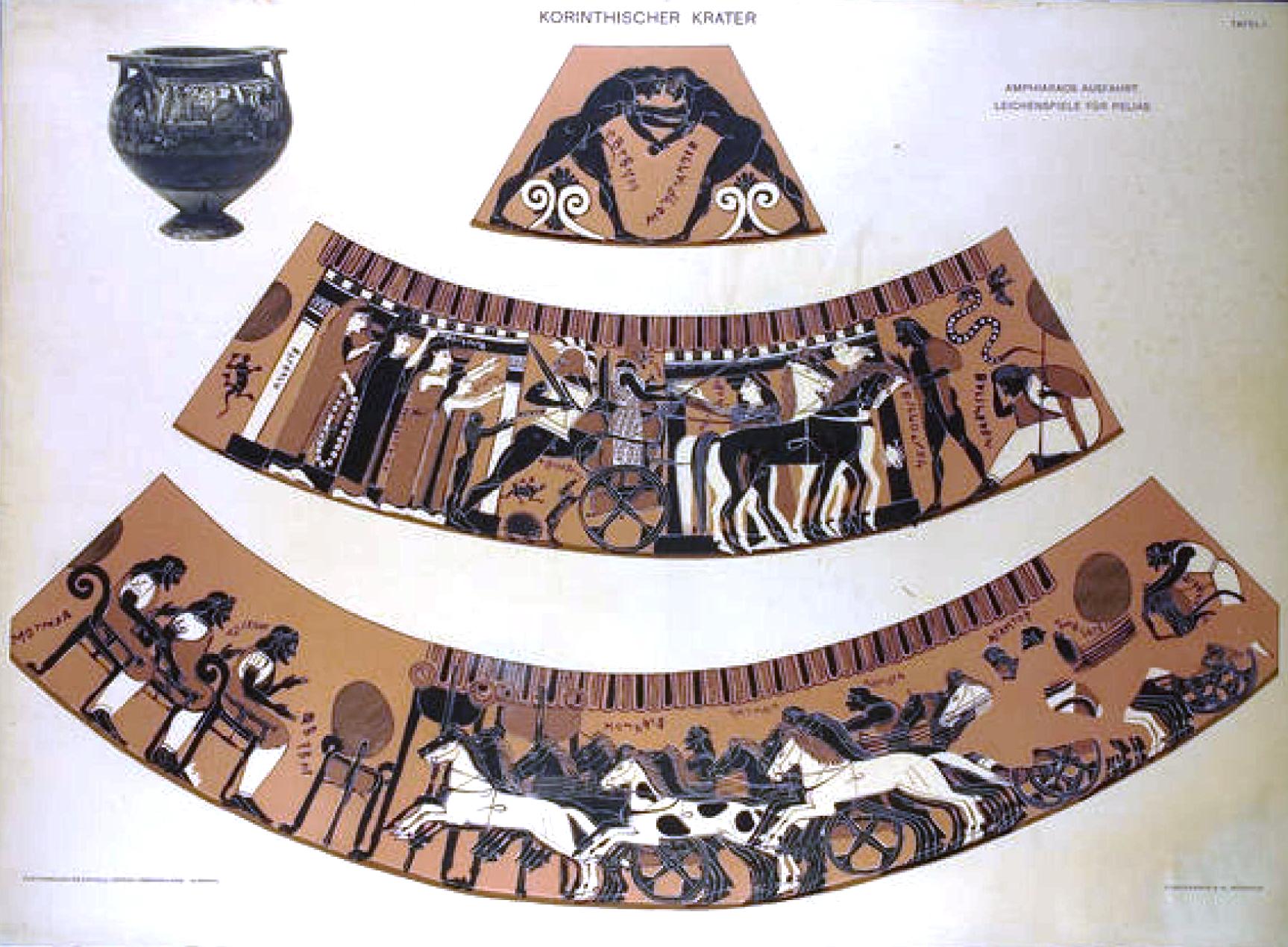
7title: Korinthischer Krater, Berlin
artist:
Amphiaraos Painterdate: between circa 570 and circa 560 BC
medium: Technique black-figure pottery
dimensions: Size cm height=46.4
current location: Antikensammlung, Staatliche Museen zu Berlin
source: Cite book|last=Furtwängler |first=Adolf |authorlink=Adolf Furtwängler |coauthors=Reichhold, Karl; Hauser, Friedrich; Buschor, Ernst; Watzinger, Carl; Zahn, Robert.|title=Griechische Vasenmalerei : Auswahl hervorragender Vasenbilder|url=linkünchen |publisher=Bruckmann. |year=1904-1932
credit: Furtwängler, Adolf; Reichhold, Karl; Hauser, Friedrich; Buschor, Ernst; Watzinger, Carl; Zahn, Robert. (1904-1932) Griechische Vasenmalerei : Auswahl hervorragender Vasenbilder, Munich: Bruckmann.
license:Public domain
 8
8title: Bell Krater with an Elderly Satyr Followed by Young Dionysos LACMA 50.8.30 (2 of 2)
artist:
Attributed to Python (Greece, South Italian, Paestan, active mid 4th century B.C.)date: between circa 350 and circa 325 B.C.
dimensions: Height- 15 in. (38.1 cm); Diameter- 14 5/8 in. (37.15 cm)
current location: Institution:Los Angeles County Museum of Art
source: *Image: link *Gallery: link Wayback|url=http%3A//collections.lacma.org/node/230077|date=20130703134142
credit: Image: link Gallery: link archive copy
description:
- South Italy, Paestum, circa 350-325 B.C.
- Furnishings; Serviceware
- Red-figure ceramic with red, yellow, and white paint, and brown wash
- Willilam Randolph Hearst Collection (50.8.30)
- greek-roman-and-etruscan-art">greek, Roman and Etruscan Art
- Currently on public view: Ahmanson Building, floor 3
license:Public domain
 9
9title: Greek krater, 460 440 BCE Wellcome L0057296
artist: unknown
source: link * Gallery: link * Wellcome Collection gallery (2018-03-29): link [link CC-BY-4.0]
credit: link Gallery: link Wellcome Collection gallery (2018-03-29): link CC-BY-4.0
description:
A krater is a greek vessel used to mix wine with water. The illustration shows the greek god Dionysius (Bacchus is the Roman equivalent) cavorting with his followers. Dionysius is the god of wine and ecstasy. His female followers were called maenads while the men were called satyrs. At the celebrations for Dionysius, worshippers became drunk and would go into trances. Miracles were believed to occur sometimes on these occasions.
artist: Cleveland Painter
Place made: Greece
Wellcome Images
Keywords: kraterlicense:

 CC BY 4.0
title: Terracotta krater MET krater001
artist:
date: late 1st quarter of the 8th century B.C.
medium: Terracotta
dimensions: H. 39 in. (99.1 cm) diameter 37 in. (94 cm)
current location: Institution:Metropolitan Museum of Art
source: link Template:TheMet
credit: This file was donated to Wikimedia Commons as part of a project by the Metropolitan Museum of Art. See the Image and Data Resources Open Access Policy
description:
greek, Attic; krater, Dipylon; Vaseslicense:
 CC0
CC0






.jpg)