 MENU
MENU



 1
1title: <div class="fn"> <div >label QS:Lfr,"La Marne"</div> </div>
artist: <bdi><a href="https://en.wikipedia.org/wiki/en:Antoine_Coysevox" class="extiw" title="w:en:Antoine Coysevox">Antoine Coysevox</a> </bdi>
date: 1706 <a href="https://www.wikidata.org/wiki/Q87483685#P571" title="Edit this at Wikidata"><img alt="Edit this at Wikidata" src="https://upload.wikimedia.org/wikipedia/commons/thumb/8/8a/OOjs_UI_icon_edit-ltr-progressive.svg/10px-OOjs_UI_icon_edit-ltr-progressive.svg.png" decoding="async" width="10" height="10" style="vertical-align: text-top" srcset="https://upload.wikimedia.org/wikipedia/commons/thumb/8/8a/OOjs_UI_icon_edit-ltr-progressive.svg/15px-OOjs_UI_icon_edit-ltr-progressive.svg.png 1.5x, https://upload.wikimedia.org/wikipedia/commons/thumb/8/8a/OOjs_UI_icon_edit-ltr-progressive.svg/20px-OOjs_UI_icon_edit-ltr-progressive.svg.png 2x" data-file-width="20" data-file-height="20"></a>
dimensions: H. : 2,16 m. ; L. : 1,30 m. ; Pr. : 0,84 m.
source: own
license:Public domain
 2
2title: Renommée chevauchant Pegase Coysevox Louvre MR1824
artist: <bdi><a href="https://en.wikipedia.org/wiki/en:Antoine_Coysevox" class="extiw" title="w:en:Antoine Coysevox">Antoine Coysevox</a> </bdi>
date: 1702<div style="display: none;">date QS:P571,+1702-00-00T00:00:00Z/9</div>
medium: technique Carrara marble
dimensions: size cm height=315 width=291 depth=128
current location: :Museum:Louvre Department of Sculptures, Richelieu, loxer ground floor, Cour Marly
source: [[User:Jebulon|Jebulon]] (2010)
credit: <a href="//commons.wikimedia.org/wiki/User:Jebulon" title="User:Jebulon">Jebulon</a> (2010)
license:Public domain
 3
3title: <a href="https://en.wikipedia.org/wiki/Lady_Justice" class="extiw" title="w:Lady Justice">Justice</a>
artist: <bdi><a href="https://en.wikipedia.org/wiki/en:Antonio_Canova" class="extiw" title="w:en:Antonio Canova">Antonio Canova</a> </bdi>
date: 1792<div style="display: none;">date QS:P571,+1792-00-00T00:00:00Z/9</div>
medium: technique gypsum
dimensions: Size unit=cm height=129 width=129
current location: Institution:Gallerie di Piazza Scala it|Sezione I
source: [http://www.artgate-cariplo.it Artgate Fondazione Cariplo]
credit: <a rel="nofollow" class="external text" href="http://www.artgate-cariplo.it">Artgate Fondazione Cariplo</a>
description: <div class="description"> <p>The <a href="https://en.wikipedia.org/wiki/Relief#Bas-relief_or_low_relief" class="extiw" title="w:Relief">bas-relief</a> of the Goddess of Justice is part of a group of thirteen plaster casts – representing allegorical figures, scenes inspired by the Iliad, the Odyssey and Phaedo, and depicting two works of mercy – in the Foundation’s Congress Centre. The reliefs were executed by Canova as a gift for Abbondio Rezzonico, a member of the Roman Senate, between 1793 and 1795. Rezzonico had already commissioned from the sculptor the commemorative monument to his uncle <a rel="nofollow" class="external text" href="http://www.clementexiii.it/zoom/zoom_mostra.html">Pope Clement XIII</a>, which was erected in St. Peter’s but not unveiled until 1792, twenty-three years after the Pope’s death. In 1781, the Veneto artist had executed for the Senator the statuette <a rel="nofollow" class="external text" href="http://www.getty.edu/art/gettyguide/artObjectDetails?artobj=1521">Apollo Crowning Himself</a> now held by the Getty Museum in Los Angeles. Evidently the two men were on very friendly terms, probably also because they were both from the Veneto region. A frequenter of Rome artistic circles, Rezzonico also commissioned works from Piranesi and Pompeo Batoni – who immortalised him in a portrait now in the Museo di Bassano del Grappa. The bas-reliefs were hung in Villa Rezzonico at Bassano to create a “Canovian room”, as attested by 19th-century sources, similar to those in other aristocratic residences in Veneto (those of Zulian, Renier, Falier, Albrizi, Barisan, Cappello) as well as Rome (Villa Lante, Villa Torlonia). There is evidence that in the course of his career Canova produced various series of bas-reliefs, sometimes with different subjects, to satisfy the demands of collectors who kept up with all the current artistic trends. The most complete series of plaster casts, which were never executed in <u style="background-color:yellow;" class="">marble</u>, is in the Gipsoteca in Possagno, and another series very like the one in the Cariplo Collection, is located in the Museo Correr, Venice. </p> <p>The technique used to execute them was the <a href="https://en.wikipedia.org/wiki/Lost-wax_casting" class="extiw" title="w:Lost-wax casting">lost wax</a> process, which enables a one-off piece to be produced from a cast obtained from a prototype: this allows the artist to work on the plaster and to give it a unique quality. We know that Canova was in the habit of emphasising this original aspect also to justify the cost of producing the pieces, although he delegated the actual production to talented assistants like Vincenzo Malpieri. </p> <p>The desire to promote his own work led Canova, spurred on by the intellectuals of the day such as Pietro Giordani and Francesco Leopoldo Cicognara, to reproduce his sculptures in engravings, in order to make his production more widely known through an economical, straightforward medium. The collection of prints dedicated to “Connoisseurs and Lovers of Fine Arts”, published by the Rome bookseller Pier Luigi Scheri in 1817, is one of the finest examples of this, and the sculptor invited some of the leading artists then active in Rome, including Vincenzo Camuccini, Raffaello Morghen, Jean-Baptiste Wicar, Tommaso Minardi and Francesco Hayez, to work on the project. </p> <p>Engravings of most of the plaster reliefs were executed, with the exception of the three Allegories connected with the design for Clement XIII’s tomb. </p> <p>The story of the Rezzonico reliefs is documented in the writings of the Rome antiquarian <a href="https://it.wikipedia.org/wiki/Giovanni_Gherardo_de_Rossi" class="extiw" title="it:Giovanni Gherardo de Rossi">Giovanni Gherardo de Rossi</a>: in 1793 <a href="//commons.wikimedia.org/wiki/File:Canova_Antonio,_Allegoria_della_Speranza.jpg" class="mw-redirect" title="File:Canova Antonio, Allegoria della Speranza.jpg">Hope</a> and <a href="//commons.wikimedia.org/wiki/File:Canova_Antonio,_Allegoria_della_Carit%C3%A0.jpg" class="mw-redirect" title="File:Canova Antonio, Allegoria della Carità.jpg">Charity</a>, casts made from the figures sculpted on Clement XIII’s sarcophagus, were delivered; <a href="//commons.wikimedia.org/wiki/File:Canova_Antonio,_Briseide_consegnata_da_Achille_agli_araldi_di_Agamennone.jpg" class="mw-redirect" title="File:Canova Antonio, Briseide consegnata da Achille agli araldi di Agamennone.jpg">Achilles Delivers Briseis to Agamemnon’s Heralds</a>, <a href="//commons.wikimedia.org/wiki/File:Canova_Antonio,_Uccisione_di_Priamo.jpg" class="mw-redirect" title="File:Canova Antonio, Uccisione di Priamo.jpg">Death of Priam</a> and <a href="//commons.wikimedia.org/wiki/File:Canova_Antonio,_Socrate_beve_la_cicuta.jpg" class="mw-redirect" title="File:Canova Antonio, Socrate beve la cicuta.jpg">Socrates Drinking Hemlock</a> can be dated to the same year; and <a href="//commons.wikimedia.org/wiki/File:Canova_Antonio,_Socrate_congeda_la_propria_famiglia.jpg" class="mw-redirect" title="File:Canova Antonio, Socrate congeda la propria famiglia.jpg">Socrates Taking Leave of His Family</a>, <a href="//commons.wikimedia.org/wiki/File:Canova_Antonio,_Danza_dei_figli_di_Alcinoo.jpg" class="mw-redirect" title="File:Canova Antonio, Danza dei figli di Alcinoo.jpg">Dance of the Sons of Alcynous</a> and <a href="//commons.wikimedia.org/wiki/File:Canova_Antonio,_Ritorno_di_Telemaco.jpg" class="mw-redirect" title="File:Canova Antonio, Ritorno di Telemaco.jpg">Return of Telemachus</a> and <a href="//commons.wikimedia.org/wiki/File:Canova_Antonio,_Allegoria_della_Giustizia.jpg" class="mw-redirect" title="File:Canova Antonio, Allegoria della Giustizia.jpg">Justice</a>, to 1794. The latter is the most interesting piece in the group, since it is the artist’s original study – and therefore not featured in other series – for a figure that does not appear in the final version of the funerary monument completed between 1784 and 1792. Lastly, <a href="//commons.wikimedia.org/wiki/File:Canova_Antonio,_Critone_chiude_gli_occhi_a_Socrate.jpg" class="mw-redirect" title="File:Canova Antonio, Critone chiude gli occhi a Socrate.jpg">Crito Closing the Eyes of Socrates</a> and <a href="//commons.wikimedia.org/wiki/File:Canova_Antonio,_Offerta_del_peplo_a_Pallade.jpg" class="mw-redirect" title="File:Canova Antonio, Offerta del peplo a Pallade.jpg">Hecuba Offering the Robe to Pallas</a> arrived in Bassano del Grappa in 1795. To the same year should be dated <a href="//commons.wikimedia.org/wiki/File:Canova_Antonio,_Dar_da_mangiare_agli_affamati.jpg" class="mw-redirect" title="File:Canova Antonio, Dar da mangiare agli affamati.jpg">Feed the Hungry</a> and <a href="//commons.wikimedia.org/wiki/File:Canova_Antonio,_Insegnare_agli_ignoranti.jpg" class="mw-redirect" title="File:Canova Antonio, Insegnare agli ignoranti.jpg">Teach the Ignorant</a>, possibly executed on Rezzonico’s wishes, since he placed them in a school for children established on the premises of his villa. </p> <p>In all probability, and with the exception of the two pieces depicting works of mercy, the idea for the prototypes was developed some years earlier, as stated in Canova’s biography in Bassano: in point of fact they were executed at the same time as the funerary monument to Clement XIII, between 1783 and 1792. The technique of the plaster relief enabled Canova to experiment with a new language that was wholly Neoclassical and thus devoid of decorative elements and strict rules of perspective. These works reveal the sculptor’s attempt to adapt to contemporary literary canons, using a style that was spare and dramatic to the point of being expressionistic. </p> The bas-reliefs stayed in Bassano until 1837, when they were sold to the collector Antonio Piazza, who hung them in his mansion in Padua, which was later bought by the Counts of San Bonifacio. From there they went, as part of an inheritance, to a country house on the Verona plain, and were purchased by the Cassa di Risparmio delle Provincie Lombarde in 1991.</div>
license:CC BY-SA 3.0
 4
4title: <div class="fn"> <span ><a href="https://en.wikipedia.org/wiki/en:The_Birth_of_Venus" class="extiw" title="w:en:The Birth of Venus">The Birth of Venus</a></span> </div>
artist: <bdi><a href="https://en.wikipedia.org/wiki/en:Sandro_Botticelli" class="extiw" title="w:en:Sandro Botticelli">Sandro Botticelli</a> </bdi>
date: 1485
credit: Adjusted levels from <a href="//commons.wikimedia.org/wiki/File:Sandro_Botticelli_-_La_nascita_di_Venere_-_Google_Art_Project.jpg" title="File:Sandro Botticelli - La nascita di Venere - Google Art Project.jpg">File:Sandro Botticelli - La nascita di Venere - Google Art Project.jpg</a>, originally from Google Art Project. Compression Photoshop level 9.
description: <div class="description"> Depicts the goddess Venus, having emerged from the sea as a fully grown woman, arriving at the sea-shore. The seashell she stands on was a symbol in classical antiquity for a woman's vulva. Thought to be based in part on the <i><a href="https://en.wikipedia.org/wiki/Venus_de%27_Medici" class="extiw" title="en:Venus de' Medici">Venus de' Medici</a></i>, an ancient Greek <u style="background-color:yellow;" class="">marble</u> sculpture of Aphrodite.</div>
license:Public domain
 5
5title: <div class="fn"> <span >Grillparzerdenkmal</span> detail</div>
artist: <bdi><a href="https://en.wikipedia.org/wiki/en:Carl_Kundmann" class="extiw" title="w:en:Carl Kundmann">Carl Kundmann</a> </bdi>
date: 1889<div style="display: none;">date QS:P571,+1889-00-00T00:00:00Z/9</div>
medium: technique marble
source: own
license:CC BY-SA 4.0
 6
6title: <i>Horace child</i>
artist: <bdi><a href="https://www.wikidata.org/wiki/Q17453601" class="extiw" title="d:Q17453601">Joseph-Alexandre Renoir</a> </bdi>
date: 1850<div style="display: none;">date QS:P571,+1850-00-00T00:00:00Z/9</div>
medium: Technique Marble
dimensions: Size unit=cm width=140.0 height=67.0 depth=57.0 diameter=
current location: Institution:Musée des Augustins de Toulouse [[Escalier Darcy]]
source: own
license:Public domain
 7
7title: <div class="fn"> Diane</div>
artist: <bdi><a href="https://en.wikipedia.org/wiki/en:Alexandre_Falgui%C3%A8re" class="extiw" title="w:en:Alexandre Falguière">Alexandre Falguière</a> </bdi>
date: 1887<div style="display: none;">date QS:P571,+1887-00-00T00:00:00Z/9</div>
medium: Technique marble
dimensions: Size unit=cm width=70.0 height=175.0 depth=62.0 diameter=
current location: Institution:Musée des Augustins de Toulouse Augustins location|escalier Darcy
source: own
license:Public domain
 8
8title: <div class="fn"> Velleda</div>
artist: <bdi><a href="https://en.wikipedia.org/wiki/en:Laurent_Marqueste" class="extiw" title="w:en:Laurent Marqueste">Laurent Marqueste</a> </bdi>
date: circa 1877 <div style="display: none;">date QS:P571,+1877-00-00T00:00:00Z/9,P1480,Q5727902</div>
medium: Technique marble
dimensions: Size unit=cm width=72.0 height=140.0 depth=163.0 diameter=
current location: Institution:Musée des Augustins de Toulouse [[Escalier Darcy]]
source: own
license:Public domain
 9
9title: Bust of the duke of Berry at the Chambord Castle
artist: <div class="fn value"> <a href="//commons.wikimedia.org/w/index.php?title=Creator:Joseph_Varin&action=edit&redlink=1" class="new" title="Creator:Joseph Varin (page does not exist)">Creator:Joseph Varin</a> </div>
date: 1829
medium: marble
current location: Institution:Château de Chambord
source: Photographied by [[User:Tournasol7|Krzysztof Golik]]
credit: Photographied by <a href="//commons.wikimedia.org/wiki/User:Tournasol7" title="User:Tournasol7">Krzysztof Golik</a>
license:Public domain
 10
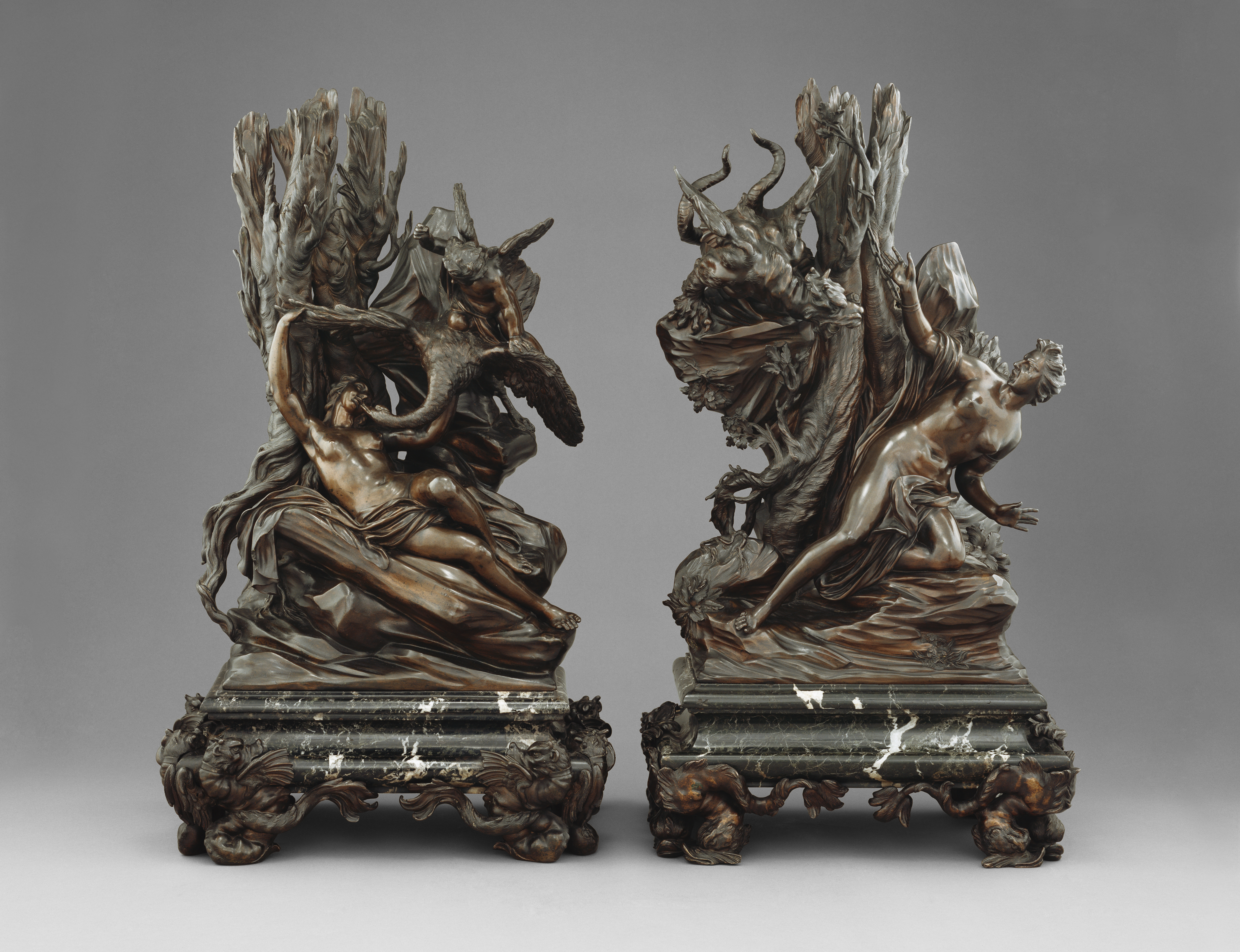
10title: <div class="fn"> <p><span >Andromeda and the Sea Monster</span> </p> <span style="font-weight:bold">Leda and the Swan</span> </div>
artist: <bdi><a href="https://en.wikipedia.org/wiki/en:Massimiliano_Soldani_Benzi" class="extiw" title="w:en:Massimiliano Soldani Benzi">Massimiliano Soldani Benzi</a> </bdi>
date: 1725<div style="display: none;">date QS:P571,+1725-00-00T00:00:00Z/9</div>
source: http://www.getty.edu/art/collection/objects/106383/massimiliano-soldani-benzi-andromeda-and-the-sea-monster-leda-and-the-swan-italian-designed-before-1717-cast-about-1725/
description: <i>Andromeda and the Sea Monster</i> (right); <i>Leda and the Swan</i> (left). Bronze on grey-green <u style="background-color:yellow;" class="">marble</u> bases with bronze mounts, 49.6 × 33.3 × 20.7 cm (19 1/2 × 13 1/8 × 8 1/8 in.), designed before 1717; cast about 1725. Object Number: 97.SB.61.1. <p>As a sea monster lunges towards her, the nude Andromeda recoils, straining against the chains that tie her to the rocky ledge. Her hair blows behind her, indicating sudden movement. The sharp angles of her eyebrows and nose express anxiety, while the diagonal of her body expresses the repulsion she feels towards the growling beast. </p> <p><i>Andromeda and the Sea Monster</i> depicts a dramatic moment from the ancient Greek author Euripides' tale of Andromeda and Perseus. Andromeda's mother angered the gods with her boast that Andromeda was more beautiful than the Nereids, the attendants of the god of the sea, Poseidon. To appease the offended Poseidon, who threatened to destroy their entire kingdom, Andromeda's parents sacrificed their daughter by leaving her where she would be devoured by his monster. As Andromeda awaits the monster, chained to a rock, Perseus flies overhead, falls instantly in love with her, and rescues her by slaying the beast. Massimiliano Soldani Benzi's interpretation of the story is unusual because he focused on Andromeda's horror at the monster instead of on her rescue. </p> <p>Master sculptor Massimiliano Soldani Benzi cast the bronze groups of <i>Andromeda and the Sea Monster</i> and <i>Leda and the Swan</i> as pendants. Each depicts an episode from classical mythology, and the two are visually linked by opposing compositions. Leda reclines, forming a diagonal from the lower right to the upper left. This line is balanced by that created by Andromeda—a diagonal moving from the lower left to the upper right—as she attempts to escape. Both figures also display heightened emotion: Leda expresses seductive eroticism, and Andromeda expresses terrifying horror. </p> <p>Each group retains its original base, golden reddish lacquer patina, and elaborate matching bronze mounts on the base. </p> Description: [CC-BY-SA-4.0] J. Paul Getty Trust.
license:Public domain