 MENU
MENU



 1
1title: <div class="fn"> <span ><span dir="ltr" lang="en"><i>Christ Before Pilate</i></span></span><div style="display: none;">label QS:Len,"Christ Before Pilate"</div> <div style="display: none;">label QS:Lfr,"Le Christ devant Pilate"</div> <div style="display: none;">label QS:Lnl,"Christus voor Pilatus"</div> </div>
artist: <bdi>Follower of <a href="https://en.wikipedia.org/wiki/en:Hieronymus_Bosch" class="extiw" title="w:en:Hieronymus Bosch">Hieronymus Bosch</a> </bdi>
date: Circa 1520 <div style="display: none;">date QS:P571,+1520-00-00T00:00:00Z/9,P1480,Q5727902</div>
medium: ucfirst: technique oil and=tempera oak panel
dimensions: Size cm height=80 width=104
current location: Institution:Princeton University Art Museum
source: gerome.canalblog.com : [http://gerome.canalblog.com Home] : [http://gerome.canalblog.com/archives/2006/01/21/1252118.html Info] : [http://static.canalblog.com/storagev1/gerome.canalblog.com/images/FOLLOWER_OF_HIERONYMUS_BOSCH_CHRIST_BEFORE_PILATE_PRINCETON_LS_D100_1.jpg Pic]
credit: gerome.canalblog.com : <a rel="nofollow" class="external text" href="http://gerome.canalblog.com">Home</a> : <a rel="nofollow" class="external text" href="http://gerome.canalblog.com/archives/2006/01/21/1252118.html">Info</a> : <a rel="nofollow" class="external text" href="http://static.canalblog.com/storagev1/gerome.canalblog.com/images/FOLLOWER_OF_HIERONYMUS_BOSCH_CHRIST_BEFORE_PILATE_PRINCETON_LS_D100_1.jpg">Pic</a>
description: <div class="description"> Christ is a center of calm and beauty amidst the howling mob that has brought him to trial before Pontius Pilate. The governor is ready to wash his hands of Jesus, saying “I am innocent of the blood of this just person: see ye to it” and delivering him to be scourged and crucified (Matthew 27:24–26). The artist seems familiar with Leonardo <u style="background-color:yellow;" class="">da</u> <u style="background-color:yellow;" class="">Vinci</u>’s <u style="background-color:yellow;" class="">studies</u> of “ideal ugliness,” counterparts to his <u style="background-color:yellow;" class="">studies</u> of “ideal beauty,” and has used bizarre visages to convey the degradation of fallen humanity. The viewer sees up-close the gruesome figures with distorted features and nose rings thanks to the half-length format and crowding of figures against the picture plane. These are typical features of a type of Flemish devotional picture then in favor. The Gothic architectural elements in the upper corners suggest the staged quality of the scene and create a theater of piety and morality that suspends Pilate’s action in time.</div>
license:Public domain
 2
2title: <div class="fn"> Sheet of Studies and Sketches</div>
artist: <div class="fn value"> Edgar Degas</div>
date: 1858<div style="display: none;">date QS:P571,+1858-00-00T00:00:00Z/9</div>
medium: Graphite (central head study), pen and brown ink, brush and brown wash, and watercolor
dimensions: Sheet: 30.3 x 23.5 cm (11 15/16 x 9 1/4 in.)
current location: institution:Cleveland Museum of Art
source: https://clevelandart.org/art/1951.430
credit: <a rel="nofollow" class="external free" href="https://clevelandart.org/art/1951.430">https://clevelandart.org/art/1951.430</a>
description: <div class="description"> Although the sheet is inscribed "Flor. 1857" in the artist’s own <u style="background-color:yellow;" class="">hand</u>, the date is incorrect. Degas visited Florence for the first time in 1858 and must have written the inscription many years later. The fragmented, disassociated imagery makes the drawing a beguiling document of artistic process and the young artist’s engagement with the art of the past. The refined female head drawn in graphite was copied from a drawing then attributed to Leonardo <u style="background-color:yellow;" class="">da</u> <u style="background-color:yellow;" class="">Vinci</u> in the Uffizi Gallery. Other sketches show Degas’s responses to Florentine sculpture. The small study in the upper right was likely made from life, perhaps an impromptu portrait of his cousin Giulia Bellelli.</div>
license:CC0
 3
3title: <div class="fn"> Sheet of Studies and Sketches</div>
artist: <div class="fn value"> Edgar Degas</div>
date: 1858<div style="display: none;">date QS:P571,+1858-00-00T00:00:00Z/9</div>
medium: Graphite (central head study), pen and brown ink, brush and brown wash, and watercolor
dimensions: Sheet: 30.3 x 23.5 cm (11 15/16 x 9 1/4 in.)
current location: institution:Cleveland Museum of Art
source: https://clevelandart.org/art/1951.430
credit: <a rel="nofollow" class="external free" href="https://clevelandart.org/art/1951.430">https://clevelandart.org/art/1951.430</a>
description: <div class="description"> Although the sheet is inscribed "Flor. 1857" in the artist's own <u style="background-color:yellow;" class="">hand</u>, the date is incorrect. Degas visited Florence for the first time in 1858 and must have written the inscription many years later. The fragmented, disassociated imagery makes the drawing a beguiling document of artistic process and the young artist's engagement with the art of the past. The refined female head drawn in graphite was copied from a drawing then attributed to Leonardo <u style="background-color:yellow;" class="">da</u> <u style="background-color:yellow;" class="">Vinci</u> in the Uffizi Gallery. Other sketches show Degas's responses to Florentine sculpture. The small study in the upper right was likely made from life, perhaps an impromptu portrait of his cousin Giulia Bellelli.</div>
license:CC0
 4
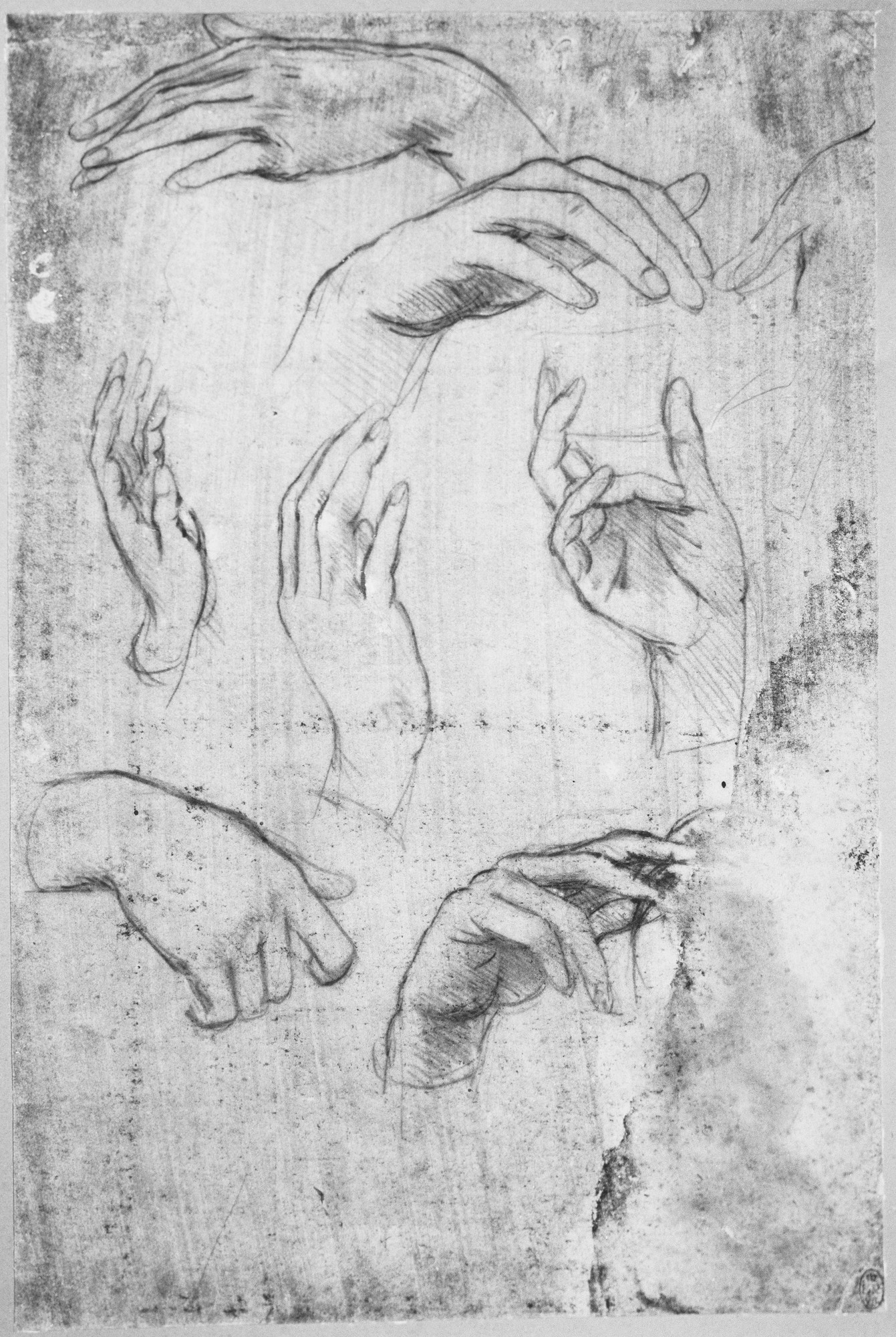
4title: Leonardo da Vinci - RCIN 912558, A study of a woman's hands c.1490
artist: <bdi><a href="https://en.wikipedia.org/wiki/en:Leonardo_da_Vinci" class="extiw" title="w:en:Leonardo da Vinci">Leonardo da Vinci</a> </bdi>
source: https://www.rct.uk/collection/
credit: <a rel="nofollow" class="external free" href="https://www.rct.uk/collection/">https://www.rct.uk/collection/</a>
license:Public domain
 5
5title: Leonardo da Vinci - RCIN 912558, v, A study of a woman's hands c.1490
artist: <bdi><a href="https://en.wikipedia.org/wiki/en:Leonardo_da_Vinci" class="extiw" title="w:en:Leonardo da Vinci">Leonardo da Vinci</a> </bdi>
source: https://www.rct.uk/collection/
credit: <a rel="nofollow" class="external free" href="https://www.rct.uk/collection/">https://www.rct.uk/collection/</a>
license:Public domain
 6
6title: Leonardo da Vinci - RCIN 912616, Studies of hands c.1480
artist: <bdi><a href="https://en.wikipedia.org/wiki/en:Leonardo_da_Vinci" class="extiw" title="w:en:Leonardo da Vinci">Leonardo da Vinci</a> </bdi>
source: https://www.rct.uk/collection/
credit: <a rel="nofollow" class="external free" href="https://www.rct.uk/collection/">https://www.rct.uk/collection/</a>
license:Public domain
 7
7title: Leonardo da Vinci - RCIN 912616, v, Studies of hands c.1480
artist: <bdi><a href="https://en.wikipedia.org/wiki/en:Leonardo_da_Vinci" class="extiw" title="w:en:Leonardo da Vinci">Leonardo da Vinci</a> </bdi>
source: https://www.rct.uk/collection/
credit: <a rel="nofollow" class="external free" href="https://www.rct.uk/collection/">https://www.rct.uk/collection/</a>
license:Public domain
 8
8title: Leonardo da Vinci - RCIN 912615, Studies of hands c.1480
artist: <bdi><a href="https://en.wikipedia.org/wiki/en:Leonardo_da_Vinci" class="extiw" title="w:en:Leonardo da Vinci">Leonardo da Vinci</a> </bdi>
source: https://www.rct.uk/collection/
credit: <a rel="nofollow" class="external free" href="https://www.rct.uk/collection/">https://www.rct.uk/collection/</a>
license:Public domain
 9
9title: Leonardo da Vinci - RCIN 912615, v, Studies of hands c.1480
artist: <bdi><a href="https://en.wikipedia.org/wiki/en:Leonardo_da_Vinci" class="extiw" title="w:en:Leonardo da Vinci">Leonardo da Vinci</a> </bdi>
source: https://www.rct.uk/collection/
credit: <a rel="nofollow" class="external free" href="https://www.rct.uk/collection/">https://www.rct.uk/collection/</a>
license:Public domain